Blog
Not everything that matters belongs on your strategy board
·Martin Börlin
#strategy-execution#strategic-alignment#prioritization#north-star-framework
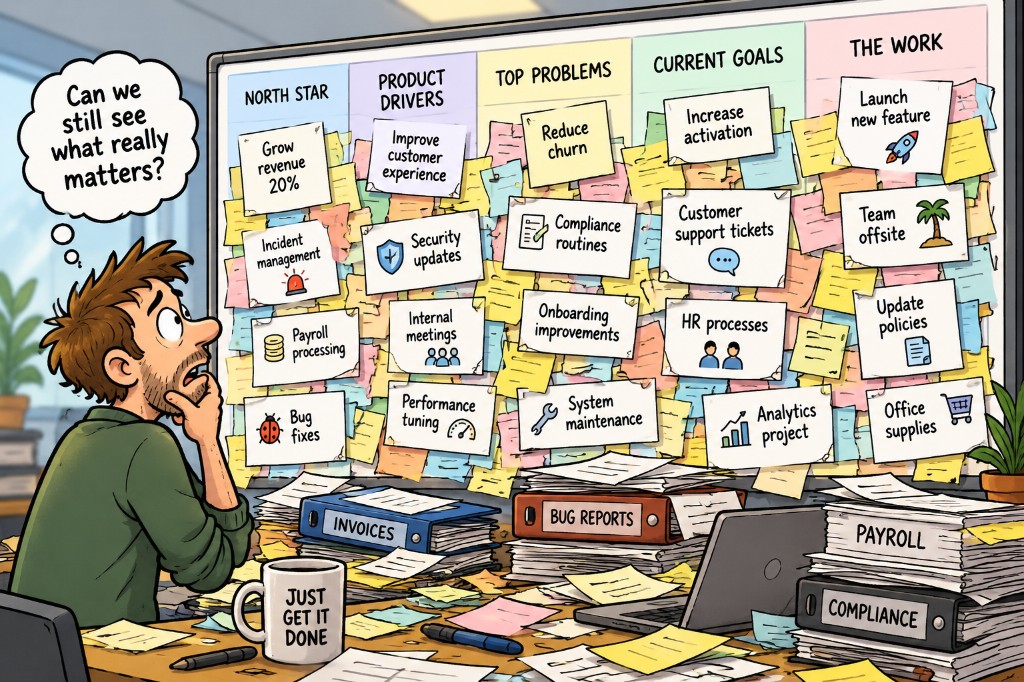
Imagine opening your company's strategy board and finding everything on it. Product initiatives, customer support tickets, payroll processing, maintenance, compliance routines, bug fixes, and the occasional internal meeting.
It might look impressively comprehensive. But can you still see what the organization is trying to change?
Not everything that matters belongs on your strategy board.
That distinction is easy to miss. Especially when leaders want transparency, teams want their contributions recognized, and everyone is trying to connect their work to a shared direction.
Running the business is not the same as improving it
Every organization has work that keeps it operating. Customers need support. Salaries need to be paid. Systems need maintenance. Incidents need attention. Regulations need to be followed.
Some of this work is absolutely business-critical. If payroll fails, people notice. If production goes down, customers notice even faster.
But doing this work well does not automatically mean the organization has made strategic progress. Often, it means the organization has successfully maintained the value it already delivers.
That is not a criticism. It is an important distinction between running the business and improving the business.
Both deserve attention, resources, and accountability. They simply do not always need the same planning and follow-up mechanisms.
The same team can do both
Consider a payroll department. Most of its work may consist of recurring payroll processing, answering questions, and ensuring compliance. This work belongs in its operational processes and tools.
Now imagine recurring payroll errors are causing frustration, consuming time, and undermining employee trust. The organization decides that reducing these errors is an important problem to solve.
Suddenly, part of the payroll team's work has a different purpose. It is no longer just processing this month's salaries. It is changing how payroll works so that next month's process is better.
That improvement initiative may deserve a place on the strategy board, provided it connects to a genuinely prioritized problem and a measurable goal.
The same applies to product development. Fixing a production incident is important, but it does not necessarily belong on the strategy board. A focused initiative to reduce recurring incidents, improve reliability, and address a prioritized customer problem might.
The difference is not which department does the work. It is what the work is intended to achieve.
A strategy board is not a second task manager
One temptation when introducing a framework is to make it the place where all work is tracked. It feels logical: if the board is meant to connect strategy to execution, shouldn't everything appear there?
I would argue the opposite.
The more operational detail you add, the harder it becomes to see the few things that matter most strategically. The board turns into another backlog, another status report, or another tool that people have to keep updated.
And if teams already use Jira, Linear, spreadsheets, or specialized operational systems, duplicating that work creates administration without necessarily creating clarity.
In the North Star Framework, the board serves a more specific purpose. It makes the relationship visible between:
North Star → Product Drivers → Top Problems → Current Goals → The Work
The question is not whether a task is important. It is whether the work helps achieve a Current Goal, address a Top Problem, and ultimately move the organization toward its North Star.
The board shows that strategic connection. The detailed execution can remain in the tools teams already use.
Don't turn visibility into a performance metric
A product team might spend 80% of its time on improvements linked to Current Goals. A payroll team might spend 5%, or have no strategic improvement initiative at all during a particular cycle.
Those numbers are examples, not targets.
It would be a serious mistake to conclude that the product team contributes more value simply because more of its work appears on the board.
A team can be essential to the business without having a single item on the strategy board this cycle. In fact, the organization's ability to pursue strategic change often depends on other teams keeping everyday operations reliable.
Board coverage is not a measure of team value.
If leaders start rewarding teams for how much work they manage to put on the board, the board will quickly fill with activities that were never meant to be there. What started as a tool for clarity becomes a competition for visibility.
A simple question before adding work
Before placing an initiative on your strategy board, ask:
What are we trying to make different, and which Current Goal does this work help us achieve?
If there is a clear answer, and the goal addresses one of the organization's prioritized problems, the initiative probably belongs there.
If the answer is simply "because it needs to get done," that may be perfectly valid. It just means the work probably belongs in an operational workflow instead.
There are exceptions and grey areas. Reliability, security, and compliance improvements can absolutely be strategic. But they should earn their place through a meaningful problem and intended outcome, not merely because the work is important or urgent.
Clarity comes from what you leave out
A useful strategy board is not a complete picture of everything happening in an organization. It is a shared picture of the changes the organization has chosen to pursue, why they matter, and how teams intend to make progress.
That requires discipline. Not only in deciding what to prioritize, but also in deciding what not to put on the board.
Operational work still needs to be planned, supported, and managed. Strategic work needs a visible connection to the outcomes we are trying to create.
When we keep those purposes distinct, the board becomes easier to understand and far more useful for conversations between leadership and teams.
The goal is not to make all work visible in one place. It is to make strategic progress impossible to lose sight of.
If you want to explore what that looks like in practice, take a look at NSF Board.