Blog
Strategy slides do not scale
·Martin Börlin
#product-strategy#strategy-execution#organizational-alignment#north-star-framework
Strategy often looks great in slides.
Clear direction. Well-formulated priorities. A strong narrative. A neat structure that makes perfect sense in the room.
And then Monday happens.
Teams return to their roadmaps, backlogs, customer conversations, incidents, deadlines, campaigns, sales opportunities, and support queues. The strategy still exists, but it no longer lives where decisions are made. It lives in a deck. Maybe in a folder. Maybe in a recording from the kickoff. Maybe in the memory of the people who were in the room when it was presented.
That is where the drift begins.
Not because the strategy was bad.
Not because people ignored it.
Not because teams were careless.
But because slides do not scale.
They capture a moment in time. They can create shared understanding in a room. But they rarely create a shared operating system for the months of decisions that follow.
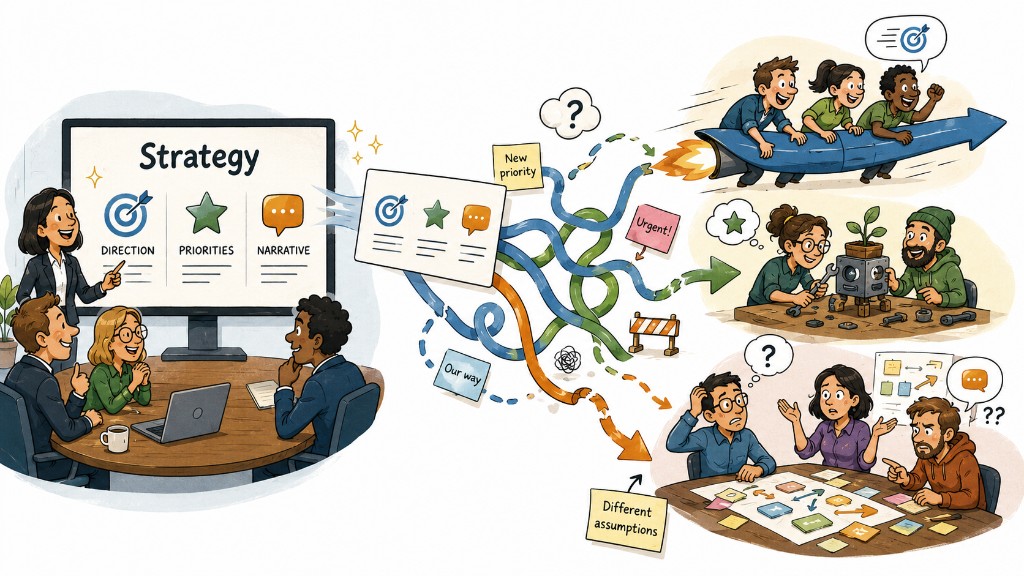
The illusion of alignment
A good strategy presentation can create a powerful feeling of alignment.
Everyone nods. The story makes sense. The priorities feel clear. The leadership team leaves the room with confidence. The teams leave with energy. For a short while, it feels like everyone is moving in the same direction.
But alignment created by a presentation is fragile.
It depends on memory.
It depends on interpretation.
It depends on people having heard the same thing, understood the same thing, and applied the same thing in the same way.
That is a lot to ask from a slide deck.
The problem is that strategy rarely fails dramatically. It usually degrades quietly.
One team interprets the priority as speed.
Another interprets it as quality.
A third interprets it as enterprise readiness.
A fourth continues with what was already in the backlog because the connection between the new strategy and the existing work was never made explicit.
A few weeks later, everyone is still working hard. But they are no longer necessarily working on the same version of the strategy.
Strategy does not break in the boardroom
In my experience, strategy is rarely what breaks first.
The breakdown usually happens when strategy needs to become everyday work.
That is the difficult part.
Not writing the vision.
Not choosing the priorities.
Not creating the narrative.
The difficult part is helping different teams, functions, and leaders make hundreds of smaller decisions that still point in the same direction.
What should we prioritize this cycle?
Which customer problem matters most right now?
Which initiative should wait?
How does this campaign connect to the product strategy?
Why is this technical investment important now?
What does this roadmap item actually move?
A slide deck can describe the answer once.
But teams need to reason about these questions continuously.
Alignment happens in structure, not only in meetings
Many organizations try to solve this with more meetings.
More leadership updates.
More roadmap reviews.
More status reports.
More quarterly presentations.
Sometimes that helps. But often it creates the appearance of alignment rather than the reality of it.
Meetings are useful for discussion, but they are a weak place to store shared understanding.
If alignment only exists when people are in the same room, it is not really embedded. It is borrowed for the duration of the meeting.
For alignment to scale, it needs structure.
Not heavy process. Not bureaucracy. Not another framework that tells everyone exactly how to work.
But a visible structure that helps people understand how the strategic direction connects to the problems the organization is trying to solve, the goals teams are working toward, and the concrete work happening in the current cycle.
Without that structure, strategy becomes too easy to reinterpret.
The missing middle between strategy and work
A common pattern in growing companies is that strategy and execution exist in separate worlds.
At the top, there is strategy:
- vision
- company priorities
- OKRs
- product bets
- board material
- leadership narratives
At the bottom, there is work:
- tickets
- tasks
- features
- campaigns
- customer calls
- bugs
- experiments
The gap is the middle.
That middle is where meaning is either preserved or lost.
If the organization jumps directly from strategy to goals, something important is often missing: the problems.
What is standing in the way?
Why is this the right thing to focus on now?
What do we believe will move the business or the customer experience forward?
What are we trying to learn?
This is where many strategy processes become too abstract for teams and too operational for leadership. The connection is there in theory, but not in a form that people can use every day.
From strategy to problems to goals to work
This is one of the reasons I find the North Star Framework so useful.
It creates a chain of reasoning from long-term direction to daily execution:
- North Star: the long-term direction and value the organization wants to create
- Product Drivers: the forces that move the organization toward the North Star
- Top Problems: the most important problems to solve right now
- Current Goals: the outcomes for the current cycle
- The Work: the activities, experiments, and tasks performed to achieve those goals
The power is not in the words themselves.
The power is in the chain.
When the chain is visible, people can see why work exists. They can challenge it. They can improve it. They can notice when something no longer connects.
Instead of asking only:
“What are we building?”
Teams can ask:
“What problem are we trying to solve?”
Instead of leadership asking only:
“Are we on track?”
They can ask:
“What are we learning about what actually moves us forward?”
That shift matters.
Because when work is connected to problems, and problems are connected to strategic drivers, the organization becomes much harder to misalign by accident.
The problem with strategy that lives outside the workflow
A strategy that lives outside the workflow will always compete with the workflow.
And the workflow usually wins.
Not because it is more important, but because it is closer.
The backlog is closer.
The sales target is closer.
The customer escalation is closer.
The campaign deadline is closer.
The sprint planning is closer.
If strategy is not visible in those moments, it becomes background noise.
This is why I believe strategy needs to live much closer to the teams. Not as a poster on the wall or a slide in an archive, but as something that shapes how people plan, prioritize, follow up, and learn.
The strategy needs to show up when a team chooses its next goal.
It needs to show up when a product manager says no to a feature.
It needs to show up when marketing chooses which story to tell.
It needs to show up when engineering invests in platform stability instead of visible feature work.
That does not happen by repeating the strategy more often.
It happens by embedding it in how work is structured.
Slides are not the enemy
To be clear, I am not against slides.
Slides are useful. They help tell a story. They help simplify complexity. They help create a shared starting point.
But slides are a poor long-term home for strategy.
They are too static.
They are too easy to detach from the work.
They are too dependent on the presenter.
They are too far away from the day-to-day decisions where alignment is actually won or lost.
A slide deck can launch a strategy.
It cannot maintain it.
That requires something more operational.
A living board.
A visible chain.
A rhythm of planning, execution, learning, and reflection.
A way for teams to see not just what they are doing, but why it matters.
What changes when strategy becomes visible
When the connection between strategy and work becomes visible, several things change.
First, priorities become easier to discuss.
Not always easier to decide, but easier to discuss. People can point to the same structure and ask better questions. Does this work support one of our current goals? Does that goal solve a real Top Problem? Is that problem connected to a Product Driver we actually believe matters?
Second, cross-functional collaboration improves.
When teams can see the same problem, they can contribute from different angles. Product can change the experience. Marketing can change the message. Customer Success can change the onboarding. Sales can bring better feedback from the market.
The problem becomes the shared object, not the department.
Third, leadership gets better visibility without asking for more reporting.
A good strategy structure should make progress understandable without another status deck. It should show what teams are working on, what they are trying to learn, where confidence is high or low, and how it all connects.
Fourth, teams get more autonomy without losing direction.
Autonomy without context creates local optimization. Context without autonomy creates frustration. The sweet spot is when teams understand the direction clearly enough to make better decisions themselves.
Strategy should become part of the operating rhythm
The real test of a strategy is not whether people understood it when it was presented.
The real test is whether it still guides decisions three weeks later, when trade-offs are hard and nobody from the leadership team is in the room.
That is why rhythm matters.
Strategy needs recurring moments where the organization returns to the same questions:
What are we trying to move?
What is blocking us right now?
What goal are we committing to in this cycle?
What work will help us learn or progress?
What changed since last time?
This rhythm does not need to be complicated.
But it needs to exist.
Without rhythm, even the best strategy becomes a document.
With rhythm, strategy becomes a way of working.
The real risk is not a bad strategy
Many organizations worry about whether their strategy is good enough.
That is a fair concern.
But in practice, I think another risk is just as common: having a decent strategy that never becomes operationally useful.
A strategy that sounds right, but does not help teams choose.
A strategy that inspires, but does not clarify trade-offs.
A strategy that aligns the room, but not the organization.
That kind of strategy can be dangerous because it creates confidence without creating a system for maintaining alignment.
Everyone remembers the direction slightly differently.
Everyone optimizes locally.
Everyone still believes they are following the strategy.
Until the gap becomes too large to ignore.
Make strategy something teams can move inside
The point is not to create more process around strategy.
The point is to create a structure that teams can move inside.
A structure where strategic direction, priorities, problems, goals, and work are visible at the same time.
A structure where teams can understand their contribution without needing another presentation.
A structure where leadership can see whether the organization is learning, not just delivering.
That is the problem I find very interesting to solve.
Because when strategy lives only in slides, alignment depends on memory.
But when strategy lives in the way people work, alignment becomes part of the system.
And that is when strategy has a chance to scale.
If you want to explore what this can look like in practice, you can try NSF Board or read more about the thinking behind it in North Star Framework from the Trenches.